Published · by Administrator
Comparing the strengths and limits of both inverter types for Thai homes.
แปลเป็นภาษาอังกฤษสำหรับนำไปใช้ประกอบสื่อ ดังนี้ครับ
Choosing Between String Inverter vs. Micro Inverter
The choice between a String Inverter and a Micro Inverter mainly depends on your roof characteristics, budget, and safety requirements. Here is a summary of the pros, cons, and how to choose the right fit for your home:
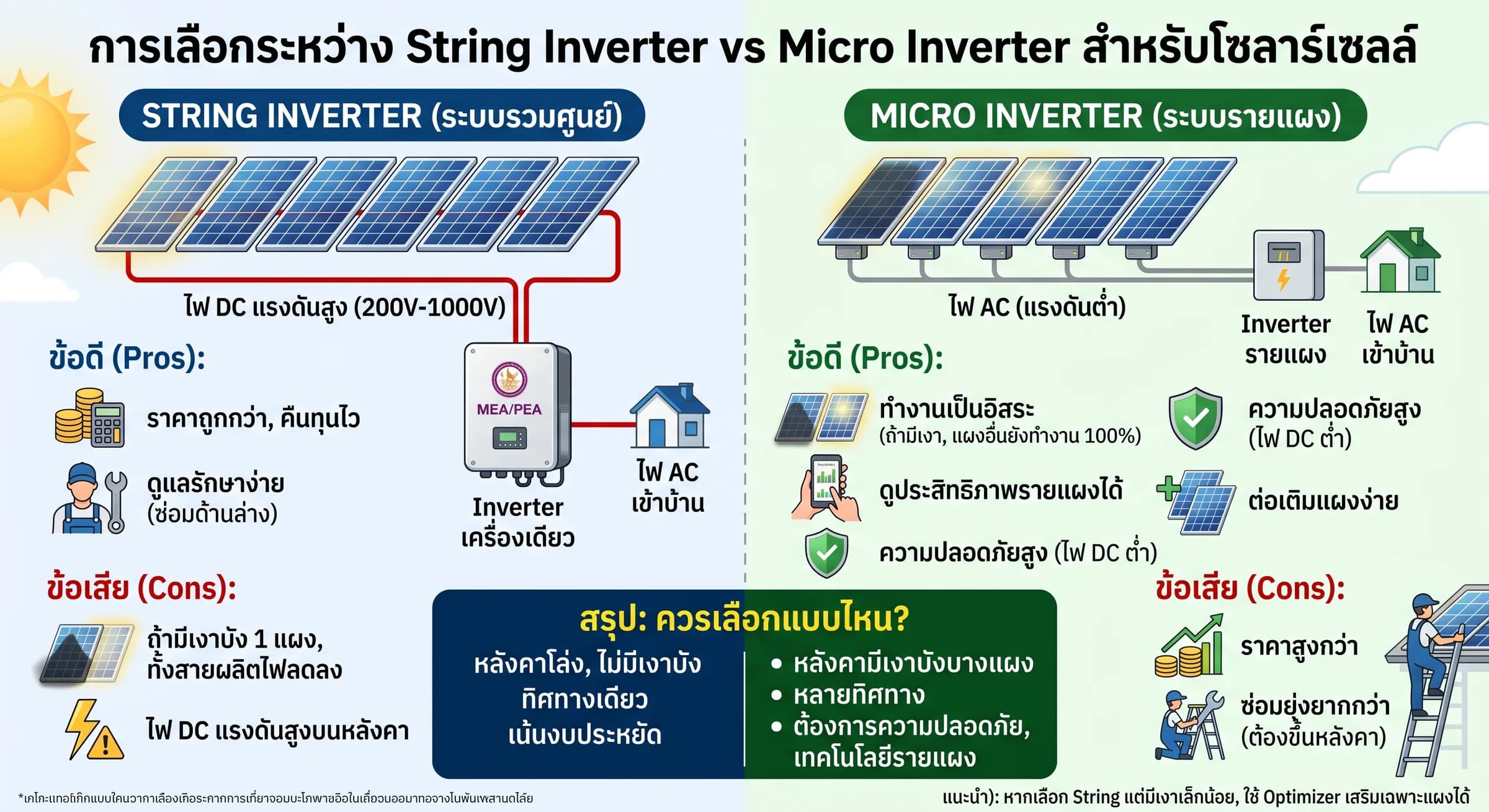
1. String Inverter (Centralized System)
Connects multiple solar panels in series (a "string") and runs high-voltage direct current (DC) wiring down to a single large inverter unit installed on a lower wall.
Pros:
More Affordable: Lower initial equipment costs and a faster payback period.
Easier Maintenance: The main inverter unit is installed at ground level, allowing technicians to inspect and service it without climbing onto the roof.
Cons:
Vulnerable to Shading: If a single panel is shaded, covered in dust, or soiled by bird droppings, the performance of all other panels in that string drops to match the lowest-performing panel.
High-Voltage DC: High-voltage DC current (200V–1,000V) runs from the roof to the inverter, requiring strict wiring standards and protective measures.
2. Micro Inverter (Panel-Level System)
Uses small individual inverters installed directly beneath each solar panel (1:1 or 1 to 2–4 panels) to convert DC to AC power immediately on the roof.
Pros:
Independent Operation: If one panel is shaded, the remaining panels continue to operate at 100% capacity.
Enhanced Safety: Maintains very low DC voltage on the roof (approx. 40V–60V) and converts it instantly to AC, significantly reducing fire and electrical hazard risks.
Panel-Level Monitoring: Tracks individual panel performance via a mobile app to pinpoint issues easily.
Easy System Expansion: Convenient to add more panels in the future without being constrained by a central inverter's rated capacity limit.
Cons:
Higher Cost: Overall system cost is approximately 20–40% higher than a String Inverter setup.
More Complex Repairs: If a micro-inverter fails, technicians must climb onto the roof and remove the panel to replace the component.
Which One Should You Choose?
Choose a String Inverter if:
Your roof is wide and unshaded throughout the day (no trees, utility poles, or adjacent buildings blocking sunlight).
All panels are installed facing the same direction (e.g., facing south or west).
You want to control costs and achieve a faster return on investment (ROI).
Choose a Micro Inverter if:
Your roof experiences partial shading at different times of the day (e.g., from trees, chimneys, or satellite dishes).
Panels need to be installed across multiple roof orientations (e.g., east, west, and south).
You prioritize maximum electrical safety regarding high-voltage DC current.
You want detailed, real-time performance tracking for each individual panel.